St
Pancras International has been voted one of London's favourite landmarks
and has a rich and colourful history. St
Pancras train station commenced operations in 1868. The famous Barlow train
shed arch spans 240 feet and is over 100 feet high at its apex. On its
completion in 1868 it became the largest enclosed space in the world at that
time. St Pancras International remains one of the greatest Victorian buildings
in London. It has become the key destination for all high-speed rail in the UK and is the home of
Eurostar Trains as well.
Whether it's an almost vertical shuttle up a mountain or a voyage aboard a luxury carriage, a rail journey can be a unforgettable experience. So climb aboard and watch the landscape roll past through my blog. Discover the beauty of the world on trains. I will be happy to hear from you. E. Mail me on ravindrar@sltnet.lk
Monday, 14 May 2012
Wednesday, 9 May 2012
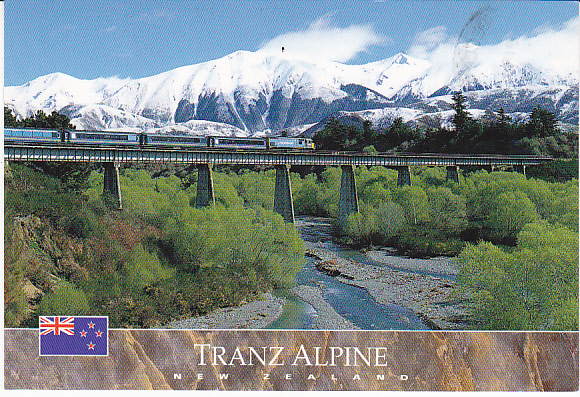
The Tranz Alpine Railway, New Zealand.
The Tranz Alpine Express
is a passenger train in New Zealand. This trip is often regarded to be one of the
world's great train journeys for the scenery through which it passes. The
journey of 223 kilometres takes about four and a half hours. There are 19 tunnels and four viaducts,
with the Staircase Viaduct being 73 metres (240 ft) high. The train runs daily between Christchurch and Greymouth. After leaving Christchurch, the train travels
through the fertile Canterbury Plains past the
Waimakariri River along
the Main South Line to Rolleston. It then turns
onto the Midland Line, which passes
through the Southern Alps past the spectacular Waimakariri River gorge, via the Otira Tunnel and terminates in Greymouth, on the West Coast.
Monday, 30 April 2012
Vaser Valley Railway, Romania - Part 1
Last of the Carpathian Forestry Railways
The
Viseu de Sus forestry railway, located in the far north of Romania close to the
border with the Ukraine, is an outstanding example of technical cultural
heritage. The line is known as the “Vaser Valley Railway” -
"vaser" comes from the local German word for water, in the time of
the Austro-Hungarian Empire. Travelling over a network of some 60
kilometers of narrow-gauge track, you will still find wood-burning steam
locomotives running alongside several diesels and railcars. CFF Viseu de
Sus ("CFF" is the Romanian abbreviation for Caile Ferate Forestiere,
meaning "Forestry Railway") is the last remaining forestry railway in
Europe.
The
track was laid at the gauge of 760 mm (the standard for narrow gauge lines
within the Austro-Hungarian Empire). The line runs alongside the Vaser River
with numerous curves, bridges and several tunnels, into a wild and romantic
valley, high in the Carpathian Mountains. The railway opens up a vast
area of isolated forest and mountain, without roads or villages but with plenty
bears and wolves instead!
................. cont Part 2
Vaser Valley Railway, Romania - Part 2
The
industrial use of timber in the Vaser Valley began at the beginning of the 18th
century, during the Austro-Hungarian Empire. German-speaking settlers
explored the forest, harvested the timber, and transported it in log rafts down
the river to the saw mills of Viseu de Sus. In 1932 the forestry railway
was built - an enormous technical advance compared with the rafting.
Forestry
railways were widespread across Europe, especially in the Carpathian Mountains.
The operating principle was very simple: they followed the rivers, often
necessitating tight curves - hence the use of the narrow gauge! The
tracks were constructed so as to enable small locomotives to pull empty logging
wagons up into the mountains and to let heavily loaded trains roll down under
gravity to the saw mills in Viseu de Sus.
While
forest roads replaced the railways in most European countries after 1945, the
forestry railways in Romania survived much longer - in 1970 the State-run
forestry administration still operated more than 3000 kilometres of
railway. Even as late as 1986 new forestry steam locomotives were being
built in Romania, and in 1989 more than 15 forestry railways were still in
existence, totalling approximately 1000 kms of line.
........ cont part 3
Vaser Valley Railway, Romania - Part 3
The
economic changes commencing in 1990 had a devastating impact on the State-run
forestry railways of the "CFF". Within a few years almost all
were decommissioned and closed, and their locomotives and wagons were scrapped
or sold. Only one of them is still operating - the Vaser River Railway.
Importantly, it still serves its primary purpose - as a forestry railway for
logging.
Ever
since 2003 the railway system has been managed by the private Romanian
corporation: "R.G. Holz Ltd", which is also the owner of the depot
area and most of the locomotives and wagons. However the railway
infrastructure, along with most of the forest in the valley, are still
State-owned.
Since
2000 the forestry railway has been receiving support from abroad, specifically
from the Swiss association "Hilfe für die Wassertalbahn"
("Help for the Vaser Valley Railway"). With assistance from
Switzerland, some disused locomotives were restored and put back into service,
new passenger coaches were purchased, and the depot and the historic station
building at Viseu were refurbished. Around the station yard in Viseu de
Sus, infrastructure is being established that takes account of the increasing
demands of tourism in the Vaser Valley.
......... cont Part 4
Subscribe to:
Posts (Atom)